

Food Identity Card
| Attribute | Details |
|---|---|
| Local Name | Ikii (pronounced Ikie) |
| Food Category | Traditional fermented cereal cake |
| Community | Kamba |
| Region | Machakos, Kitui, Makueni and other Kamba-speaking regions of Eastern Kenya |
| Country | Kenya |
| Primary Ingredients | Finger millet, sorghum, maize (optional), water |
| Preparation Technology | Kukia (traditional wet stone grinding) |
| Derived From | Ukii (Usuu wa Kukia) |
| Fermentation Type | Natural spontaneous fermentation |
| Serving Temperature | Ambient or chilled |
| Commercial Availability | Household preparation |
| Scientific Evidence Level | Limited |
| Commercialization Potential | High |
Overview
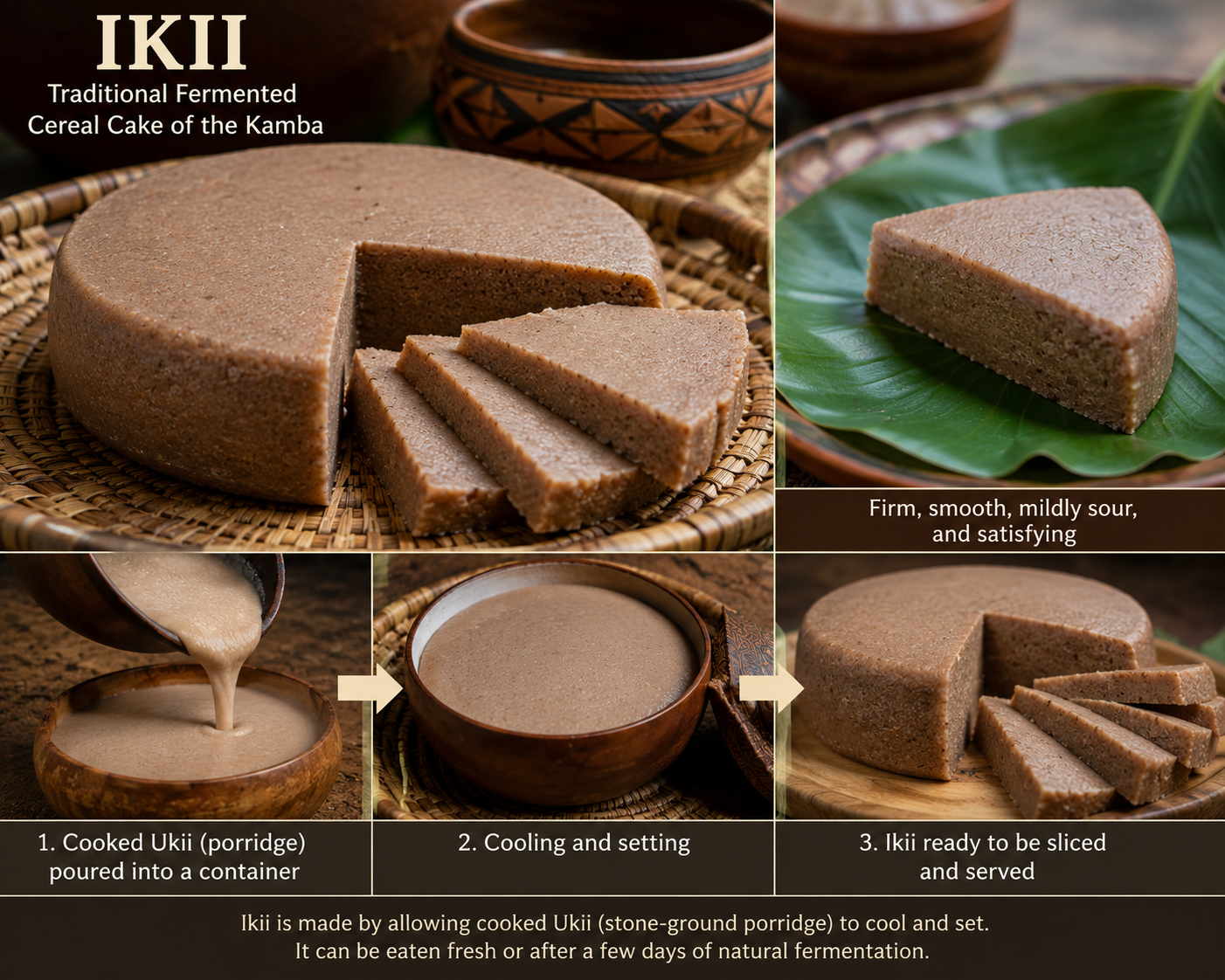
Ikii is a traditional fermented cereal cake prepared by the Kamba community of Eastern Kenya. It is produced from Ukii (Usuu wa Kukia), the smooth stone-ground porridge made using the indigenous Kukia wet stone-grinding technology. After the porridge has been cooked, it is poured into a suitable container and allowed to cool naturally. As it cools, it firms into a compact cake that can be sliced or broken into portions for consumption.
Unlike many cereal porridges that are consumed immediately after cooking, Ikii is specifically intended to be eaten after setting. Depending on household preference, it may be consumed fresh, mildly fermented, or after several days of fermentation. The degree of fermentation influences the flavour, aroma, acidity, and texture but does not create a different food. Instead, fermentation represents a continuum, allowing families to enjoy Ikii at the stage they prefer.
Ikii has long served as a convenient household food because it is easy to transport, requires no bowl for serving, and remains suitable for consumption over several days when handled hygienically. Despite its cultural importance, very little scientific literature specifically describes Ikii as a distinct product, with some publications using the term interchangeably with the fermented porridge. This article follows traditional Kamba terminology, distinguishing Ukii (the porridge) from Ikii (the cooled cereal cake).
Relationship Between Ukii and Ikii
Understanding Ikii begins with understanding Ukii.
The preparation follows a simple progression:
Traditional cereal grains
↓
Soaking
↓
Kukia (wet stone grinding)
↓
Smooth cereal slurry
↓
Cooking
↓
Ukii (stone-ground porridge)
↓
Cooling and setting
↓
Ikii (fermented cereal cake)
The only additional step required to produce Ikii is allowing the freshly cooked paste to cool and solidify. This simple transformation changes the texture, serving method, storage characteristics, and eating experience, creating a food with its own cultural identity.
History and Origin
The precise historical origin of Ikii has not been documented, but the food is deeply rooted in Kamba culinary traditions. It likely developed as an extension of Ukii preparation, allowing households to preserve cooked porridge for later consumption without the need for repeated cooking.
Before the availability of refrigeration, cooling and natural fermentation were important methods for extending the usability of cooked foods. Allowing Ukii to set into Ikii created a portable product that could be carried to farms, grazing areas, or long journeys.
Preparation knowledge was transmitted orally from one generation to another. Mothers and grandmothers taught younger family members not only how to prepare the food but also how to judge proper consistency, fermentation, and readiness for consumption.
Communities and Geographic Distribution
Ikii is traditionally associated with the Kamba community and is prepared throughout:
- Machakos County
- Kitui County
- Makueni County
- Kamba households in urban centres across Kenya
Although neighbouring communities prepare similar fermented porridges, the deliberate preparation of a cooled cereal cake known as Ikii appears to be distinctive to Kamba food culture. Additional ethnographic research is needed to determine whether closely related foods exist under different names among neighbouring communities.
Traditional Ingredients
The ingredients used to prepare Ikii are identical to those used for Ukii because the cake is derived directly from the cooked porridge.
Primary ingredients
- Finger millet
- Sorghum
- Water
Optional ingredients
- Maize
- Other locally available cereals
Traditionally, the cereals were selected according to seasonal availability and household preference. Finger millet remained the preferred grain because of its nutritional value, flavour, and ability to produce a firm, smooth cake after cooking.
Traditional Equipment
Preparation of Ikii requires the same traditional equipment used for preparing Ukii.
- Large grinding stone.
- Hand grinding stone.
- Clay cooking pot.
- Wooden stirring stick.
- Three-stone fireplace.
- Calabashes, gourds, clay pots, or woven containers for cooling and setting.
The container used for cooling influenced the final shape of the cake but did not alter its composition.
Traditional Preparation
Step 1: Grain Selection
Healthy cereal grains are carefully selected and cleaned to remove foreign materials.
Step 2: Washing
The grains are washed thoroughly using clean water.
Step 3: Soaking
The grains are soaked for several hours or overnight to soften them and facilitate wet grinding.
Step 4: Kukia
The soaked grains are ground on the traditional stone using small additions of water until an exceptionally smooth slurry is obtained.
Step 5: Cooking
The slurry is cooked over moderate heat while being stirred continuously until it forms a thick, smooth paste – not porridge. At this stage, the product is known as Ukii.
Step 6: Cooling
Instead of consuming the paste immediately, it is poured into a clean container and allowed to cool naturally and set into a cake.
Step 7: Setting
As cooling continues, the gelatinized starch network stabilizes, producing a firm cake with sufficient strength to be sliced or broken into portions.
Step 8: Fermentation
The cake may be consumed immediately after setting or allowed to ferment naturally for varying periods according to household preference. Longer fermentation produces a more pronounced sour flavour and aroma.
The Science Behind Ikii
The transformation of Ukii into Ikii is governed by well-understood principles of food science.
During cooking, starch granules absorb water and gelatinize, producing the thick consistency characteristic of Ukii. As the cooked porridge cools, starch molecules reorganize into a more ordered structure through a process known as retrogradation. This process causes the porridge to become firm, allowing it to retain its shape when cut.
Natural fermentation continues during storage. Lactic acid bacteria metabolize residual sugars, producing lactic acid that lowers the pH and contributes to the characteristic sour taste. The acidic environment also suppresses many spoilage organisms, helping preserve the product for several days under appropriate conditions.
The degree of firmness depends on several factors, including cereal composition, cooking time, water content, and cooling conditions.
Sensory Characteristics
Freshly prepared Ikii possesses distinctive sensory qualities.
Appearance
- Smooth surface.
- Uniform structure.
- Compact cake.
Colour
- Light brown to reddish brown depending on the cereals used.
Aroma
- Mild cereal aroma when freshly prepared.
- Increasingly sour aroma as fermentation progresses.
Taste
- Mildly sweet immediately after preparation.
- Pleasantly sour after fermentation.
Texture
- Firm.
- Smooth.
- Moist.
- Easily sliced.
- Non-crumbly when properly prepared.
These characteristics distinguish Ikii from both freshly cooked porridge and dry cereal products.
Nutritional and Health Value
The nutritional quality of Ikii depends largely on the cereal grains used during preparation. Traditionally, finger millet forms the major ingredient, often complemented by sorghum and, in some households, small amounts of maize. These cereals provide a rich source of complex carbohydrates that serve as the primary energy source. Finger millet is particularly valued because it contains higher levels of calcium than most commonly consumed cereals, together with appreciable amounts of iron, magnesium, phosphorus, potassium, dietary fibre, and B-complex vitamins.
Because Ikii is produced from whole grains, much of the bran and germ are retained during preparation. Unlike refined cereal products, traditional wet stone grinding distributes these components evenly throughout the food rather than removing them, thereby preserving fibre and micronutrients.
Natural fermentation may further improve the nutritional quality of Ikii by:
- Reducing phytates that interfere with mineral absorption.
- Improving the bioavailability of iron, calcium, and zinc.
- Producing organic acids that enhance mineral uptake.
- Partially breaking down starches and proteins, improving digestibility.
- Contributing beneficial microbial metabolites.
Although these benefits have been demonstrated for several African fermented cereal foods, detailed nutritional studies specifically on Ikii remain limited.
Fermentation Microbiology
Ikii undergoes spontaneous fermentation, relying on naturally occurring microorganisms associated with the cereal grains, grinding stones, utensils, water, and surrounding environment.
Studies on related Kenyan fermented cereal products indicate that fermentation is dominated by lactic acid bacteria, accompanied by yeasts. The microbial community is expected to include species such as:
Lactic Acid Bacteria
- Lactiplantibacillus plantarum
- Limosilactobacillus fermentum
- Leuconostoc mesenteroides
- Pediococcus pentosaceus
- Lactococcus lactis
Yeasts
- Saccharomyces cerevisiae
- Pichia species
- Candida species
These microorganisms produce lactic acid and other metabolites that contribute to the sour taste, characteristic aroma, and improved microbiological stability of the product. However, further work is required to characterize the microbial succession in traditionally prepared Ikii as recognized by the Kamba community, since existing scientific studies have generally focused on the fermented porridge rather than the cooled cereal cake.
Shelf Life
Freshly prepared Ikii is usually consumed within a few days.
Shelf life depends on:
- Ambient temperature.
- Degree of fermentation.
- Hygiene during preparation.
- Moisture content.
- Storage container.
Traditional households often stored Ikii in clean calabashes, clay pots, or covered containers to minimize contamination. As fermentation progresses, acidity increases and the flavour becomes more pronounced. Excessively long storage may eventually lead to spoilage, undesirable odours, mould growth, or surface drying.
Cultural Importance
Ikii has long occupied an important place in Kamba households because of its practicality and versatility.
Traditionally, it was consumed:
- As a breakfast food.
- During the day while working on farms.
- As a convenient travel food.
- By children because it could be easily broken into manageable portions.
- By elderly people because of its soft texture.
- During periods of food scarcity, when careful preservation of cooked food was important.
- During family gatherings and communal activities.
The transformation of Ukii into Ikii also reflects the ingenuity of indigenous food systems, demonstrating how a single preparation method could produce multiple foods suited to different circumstances.
Food Safety Considerations
When prepared hygienically, Ikii is generally considered a safe traditional food.
Potential food safety hazards include:
Biological Hazards
- Contaminated water.
- Poor sanitation of utensils and storage containers.
- Mould growth during prolonged storage.
- Post-processing contamination during handling.
Chemical Hazards
- Mycotoxins in poorly stored millet, sorghum, or maize before preparation.
- Chemical contamination during grain storage.
Physical Hazards
- Small stone particles from worn grinding stones.
- Sand or other foreign materials introduced during grain handling.
Traditional grain cleaning, thorough cooking, fermentation, and hygienic handling reduce many of these risks. Nevertheless, safe water, clean equipment, and proper grain storage remain essential for producing a safe product.
Commercialization Potential
Ikii possesses considerable potential for commercialization as consumer interest in indigenous and minimally processed foods continues to grow.
Potential opportunities include:
- Ready-to-eat heritage food products.
- Refrigerated traditional cereal cakes.
- Vacuum-packed products.
- Institutional feeding programmes.
- Heritage restaurants.
- Cultural tourism.
- Export to Kenyan diaspora communities.
- Premium health-food markets.
Commercial production would require standardized formulations, improved packaging, validated shelf-life studies, and food safety systems while preserving the sensory characteristics that define traditional Ikii.
Sustainability
Ikii contributes to sustainable food systems by:
- Promoting cultivation of drought-tolerant cereals such as finger millet and sorghum.
- Conserving indigenous food knowledge.
- Supporting local cereal farmers.
- Encouraging dietary diversity.
- Reducing dependence on highly refined cereal products.
- Preserving traditional processing technologies such as Kukia.
As climate change increases pressure on food systems, traditional cereals used in Ikii may become increasingly important because of their resilience under semi-arid conditions.
Research Gaps
Despite its importance within Kamba food culture, Ikii remains poorly documented scientifically.
Future research priorities include:
- Detailed nutritional composition.
- Glycaemic index.
- Mineral bioavailability.
- Characterization of fermentation microbiota.
- Shelf-life studies.
- Packaging technologies.
- Consumer sensory evaluation.
- Commercial processing methods.
- Product standardization.
- Documentation of cultural practices and terminology.
Food Scientist’s Perspective
Ikii illustrates how indigenous food systems maximize the value of locally available cereals through simple yet sophisticated processing techniques. The transition from cooked porridge to a firm fermented cake demonstrates an intuitive understanding of starch behaviour, natural fermentation, and food preservation long before these processes were scientifically described.
The combination of Kukia technology, controlled cooking, cooling, and fermentation produces a distinctive food that deserves greater scientific attention. Documenting Ikii accurately is also important for preserving Kamba culinary heritage and distinguishing it from the closely related porridge, Ukii. Future research should validate its nutritional properties, microbial ecology, and commercialization potential while respecting the traditional knowledge that has preserved this food for generations.
Interesting Facts
- Ikii is produced by allowing cooked Ukii to cool and set into a firm cake.
- The same preparation process can yield two distinct traditional foods: Ukii and Ikii.
- Fermentation time varies according to household preference rather than fixed rules.
- Finger millet is traditionally preferred because it produces a firm cake with excellent flavour and texture.
- Although scientific publications have sometimes referred to fermented porridge as “Ikii,” Kamba terminology distinguishes the porridge (Ukii) from the cooled cake (Ikii).
References
Abegaz, K. (2007). Isolation, characterization and identification of lactic acid bacteria involved in traditional fermentation of borde, an Ethiopian cereal beverage. African Journal of Biotechnology, 6(12), 1469–1478.
Kalui, C. M., Mathara, J. M., Kutima, P. M., Kiiyukia, C., & Wongo, L. E. (2008). Partial characterisation and identification of lactic acid bacteria involved in production of Ikii: A traditional fermented maize porridge by the Kamba in Kenya. Journal of Tropical Microbiology and Biotechnology, 4(1), 3–15. https://doi.org/10.4314/jtmb.v4i1.35461
Khayeka-Wandabwa, C., Choge, J., Linnemann, A. R., & Schoustra, S. (2024). Linking fermented foods to microbial composition and valorisation: Blueprint for Kenya. Food Reviews International. https://doi.org/10.1080/87559129.2024.2355992
Kunyanga, C. N., Mbugua, S. K., Kang’ethe, E. K., & Imungi, J. K. (2009). Microbiological and acidity changes during the traditional production of Kirario: An indigenous Kenyan fermented porridge produced from green maize and millet. African Journal of Food, Agriculture, Nutrition and Development, 9(6), 1419–1435.
Nout, M. J. R. (1981). Aspects of the manufacture and consumption of Kenyan traditional fermented beverages. Wageningen University. https://doi.org/10.18174/205798
Onyango, C., Okoth, M. W., & Mbugua, S. K. (2000). Effect of drying lactic fermented uji (an East African sour porridge) on some carboxylic acids. Journal of the Science of Food and Agriculture, 80(13), 1854–1858. https://doi.org/10.1002/1097-0010(200010)80:13<1854::AID-JSFA721>3.0.CO;2-5
Wafula, E. N., Muhonja, C. N., Kuja, J. O., & Owaga, E. E. (2022). Lactic acid bacteria from African fermented cereal-based products: Potential biological control agents for mycotoxins in Kenya. Journal of Food Quality, 2022, 2397767. https://doi.org/10.1155/2022/2397767