

Food Identity Card
| Attribute | Details |
|---|---|
| Local Name | Kinaa |
| Food Category | Traditional fermented cereal and milk delicacy |
| Community | Kamba (Akamba) |
| Region | Machakos, Kitui, Makueni and other Kamba-speaking areas of Eastern Kenya |
| Country | Kenya |
| Primary Ingredients | Roasted pearl millet or finger millet flour, fermented milk (or water in some households) |
| Preparation Method | Dry roasting, milling and mixing (no cooking after mixing) |
| Fermentation Type | Fermented milk provides the characteristic sour flavour; some households allow slight fermentation after mixing |
| Serving Temperature | Ambient or chilled |
| Commercial Availability | Limited but increasing |
| Scientific Evidence Level | Moderate |
| Commercialization Potential | Very High |
Overview
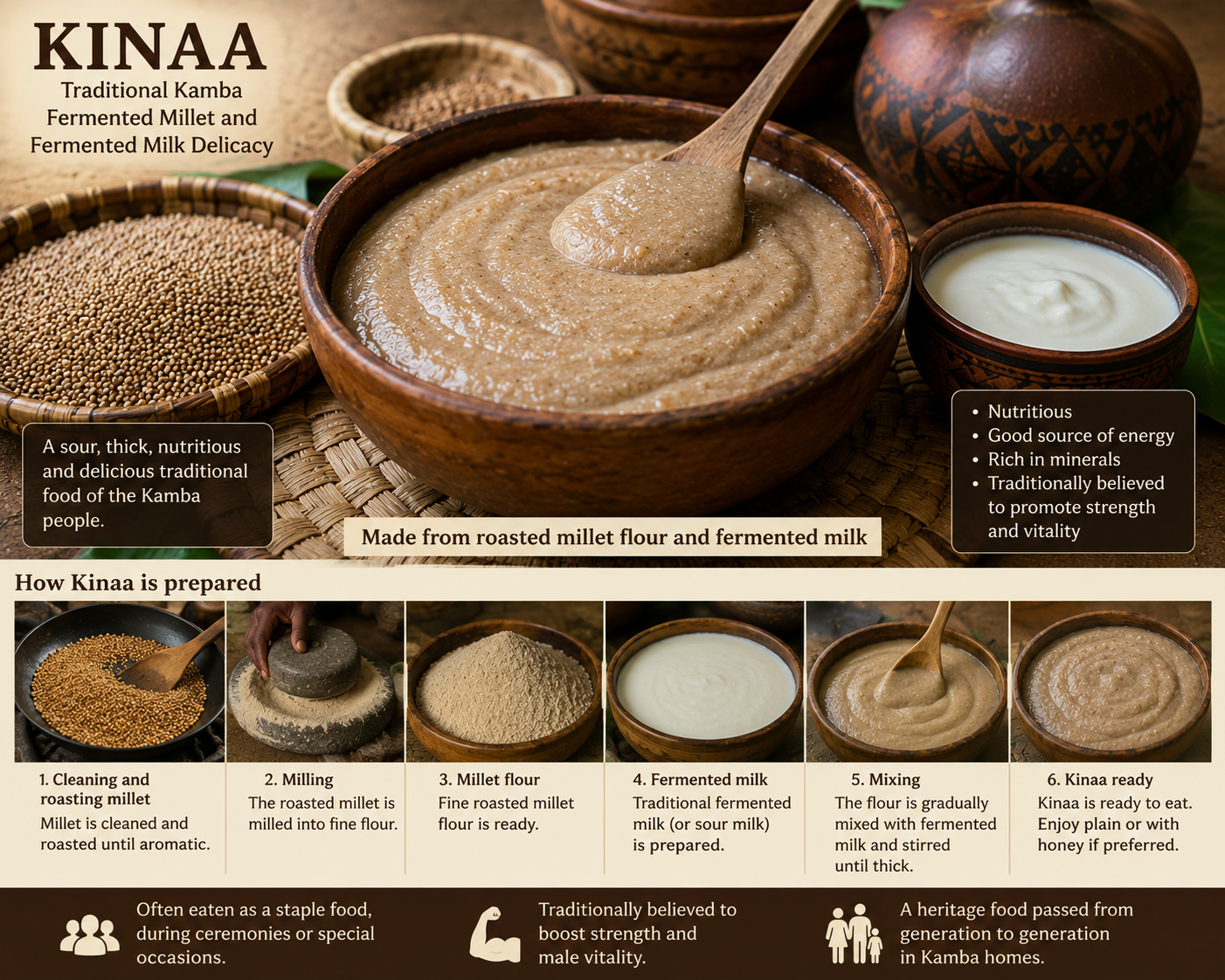
Kinaa is a traditional Kamba cereal delicacy prepared by mixing finely milled roasted millet flour with fermented milk to produce a thick, smooth, ready-to-eat paste. Unlike Ukii and Ikii, which require soaking, wet stone grinding and cooking, Kinaa is prepared from roasted flour and does not require cooking after the flour has been mixed with fermented milk. This simple preparation makes it a convenient, nutritious and highly portable food.
For generations, Kinaa has been valued as an energy-rich meal suitable for children, adults, travellers, herders and farmers. Its pleasant sour taste comes primarily from the fermented milk used during preparation, while roasting gives the millet its distinctive aroma and flavour. Some households sweeten Kinaa with honey, while others prefer its natural sour taste.
Although traditionally associated with the Kamba community, Kinaa has recently attracted wider national attention after being showcased at Kenya’s Devolution Conference, where visitors from many communities praised its flavour and nutritional value, highlighting its potential as a heritage food with commercial appeal.
History and Origin
Kinaa is one of the oldest traditional foods of the Kamba people and reflects centuries of adaptation to the semi-arid conditions of Ukambani. Millet was historically one of the most important cereals cultivated by the Kamba because it tolerates drought better than many introduced crops while providing highly nutritious grain.
The preparation of Kinaa developed as a practical solution for producing a nutritious food that required little preparation immediately before consumption. By roasting the millet first, households produced flour that could be stored for extended periods. Whenever needed, the flour was simply mixed with fermented milk to prepare a filling meal.
Knowledge of preparing Kinaa was traditionally passed from mothers and grandmothers to younger generations. Families often developed their own preferred consistency, level of sourness and choice of sweetener, resulting in slight household variations while maintaining the same basic preparation method.
Communities and Geographic Distribution
Kinaa is traditionally associated with the Kamba community, particularly in:
- Kitui County
- Machakos County
- Makueni County
Today, it is also prepared by Kamba families living in urban centres throughout Kenya and is increasingly being introduced to consumers from other communities through cultural festivals, exhibitions and food fairs. Its popularity at recent national events demonstrates growing interest beyond its traditional geographical area.
Traditional Ingredients
Traditional Kinaa is remarkably simple, relying on only a few carefully prepared ingredients.
Primary ingredients
- Pearl millet (Pennisetum glaucum) or finger millet (Eleusine coracana)
- Fermented milk
- Honey (optional)
Household variations
Some households may also use:
- Sour milk (mala)
- Fresh milk followed by natural fermentation
- Water when fermented milk is unavailable
- Small amounts of sugar as a modern adaptation
The quality of the millet largely determines the flavour, colour and texture of the finished product.
Traditional Preparation
Step 1: Grain Selection
Healthy millet grains are selected and cleaned to remove stones, dust and damaged kernels.
Step 2: Roasting
The cleaned millet is roasted slowly over moderate heat.
Roasting develops characteristic flavour compounds, reduces moisture and improves storage stability.
Step 3: Cooling
The roasted grains are allowed to cool completely.
Step 4: Milling
The roasted millet is ground into an extremely fine flour.
Traditionally this was accomplished using grinding stones before mechanical mills became available.
Step 5: Mixing
The flour is gradually mixed with fermented milk while stirring continuously until a thick, smooth paste forms.
Depending on preference, honey or small quantities of sugar may be added.
Step 6: Consumption
Kinaa is consumed immediately after preparation or after standing briefly to allow the flour to hydrate fully.
Unlike Ukii, the product is not normally cooked after mixing.
The Science Behind Kinaa
Kinaa illustrates a different indigenous food-processing pathway from other traditional Kamba cereal foods.
Rather than relying on wet grinding and cooking, it combines roasting, fine milling, and fermented dairy.
Why roasting matters
Roasting performs several important functions:
- Develops desirable nutty flavours through Maillard reactions.
- Reduces grain moisture, improving shelf life.
- Produces a pleasant aroma.
- Reduces enzyme activity associated with deterioration.
- Makes the flour suitable for direct consumption after mixing.
Why fermented milk?
Fermented milk contributes:
- Lactic acid, producing the characteristic sour taste.
- High-quality protein.
- Calcium.
- Beneficial microorganisms.
- Improved palatability.
The combination of roasted millet flour and fermented milk produces a food with complementary nutritional properties and a distinctive sensory profile. Similar combinations of cereals and fermented dairy products are recognised for their nutritional importance in East African traditional diets.
Sensory Characteristics
Properly prepared Kinaa possesses distinctive sensory characteristics.
Appearance
- Smooth paste.
- Uniform consistency.
- Free from lumps.
Colour
- Light brown to grey depending on the millet variety.
Aroma
- Pleasant roasted cereal aroma.
- Mild fermented dairy aroma.
Taste
- Slightly sour.
- Nutty.
- Rich.
- Mildly sweet when honey is added.
Texture
- Thick.
- Creamy.
- Smooth.
- Easy to scoop with a spoon.
Cultural Importance
Kinaa has traditionally been regarded as both an everyday food and a special delicacy.
It has been consumed:
- As a nutritious breakfast.
- During farm work.
- While travelling.
- By children.
- By older adults.
- During family gatherings.
- During cultural ceremonies.
Among some members of the Kamba community, Kinaa is also traditionally believed to promote physical strength and male vitality. This belief forms part of local indigenous knowledge and cultural tradition. At present, however, there is no published scientific evidence specifically evaluating these claimed effects, although millet itself is well recognised as a nutritious cereal rich in fibre, minerals and energy.
Nutritional and Health Value
Kinaa is widely regarded as one of the most nutritious traditional foods of the Kamba community because it combines the nutritional benefits of whole millet with those of fermented milk.
Millet
Traditionally, pearl millet or finger millet provides:
- Complex carbohydrates for sustained energy.
- Dietary fibre that supports digestive health.
- Plant protein.
- Calcium, particularly in finger millet.
- Iron.
- Magnesium.
- Phosphorus.
- Potassium.
- Zinc.
- B-complex vitamins.
- Natural antioxidants, particularly phenolic compounds.
Fermented Milk
Fermented milk contributes:
- High-quality protein.
- Calcium.
- Phosphorus.
- Vitamin B12.
- Riboflavin.
- Lactic acid.
- Beneficial lactic acid bacteria.
Together, these ingredients produce a food that supplies energy, protein, minerals and beneficial fermentation products.
Roasting also improves flavour while reducing moisture, allowing the flour to be stored for long periods before use. Fermentation of the milk contributes organic acids that enhance flavour and may improve mineral absorption.
Fermentation Microbiology
Unlike Ukii and Ikii, where cereal fermentation is central to product development, the principal fermentation in Kinaa originates from the milk.
Traditional fermented milk contains a diverse community of lactic acid bacteria and yeasts that contribute to acid production, flavour development and microbiological stability.
The dominant microorganisms commonly associated with East African fermented milk include:
Lactic Acid Bacteria
- Lactococcus lactis
- Lactiplantibacillus plantarum
- Lacticaseibacillus casei
- Leuconostoc mesenteroides
- Streptococcus thermophilus
Yeasts
- Kluyveromyces marxianus
- Saccharomyces cerevisiae
- Candida species
These microorganisms produce lactic acid, lowering the pH and giving Kinaa its characteristic pleasant sour taste.
Although comprehensive microbiological studies specifically on Kinaa have not yet been published, the microbial ecology is expected to resemble that of other traditional fermented milk products in East Africa.
Food Safety Considerations
Kinaa is generally safe when prepared using clean ingredients and hygienic handling practices.
Potential hazards include:
Biological Hazards
- Contaminated milk.
- Poor hygiene during preparation.
- Improper storage after mixing.
- Growth of spoilage microorganisms if left at ambient temperature for extended periods.
Chemical Hazards
- Aflatoxins in poorly stored millet.
- Chemical contaminants introduced during storage.
Physical Hazards
- Stone fragments from traditional milling.
- Sand or foreign materials in inadequately cleaned millet.
Because Kinaa is not cooked after mixing, the microbiological quality of the fermented milk is particularly important. Fresh, hygienically prepared fermented milk greatly reduces the risk of contamination.
Commercialization Potential
Kinaa has enormous potential as a premium indigenous food.
Possible commercial products include:
- Ready-to-mix roasted millet flour.
- Instant Kinaa mixes.
- Refrigerated ready-to-eat products.
- Individual serving packs.
- School feeding products.
- Sports nutrition products.
- Health-food products.
- Heritage restaurant menus.
- Cultural tourism experiences.
Its simplicity, nutritional value and convenience make it well suited for modern consumers seeking minimally processed traditional foods.
The growing interest shown by visitors at cultural exhibitions demonstrates that Kinaa could become one of Kenya’s flagship indigenous foods if appropriately branded and marketed.
Sustainability
Kinaa contributes to sustainable food systems because it promotes the use of traditional drought-tolerant cereals.
Benefits include:
- Encouraging cultivation of pearl millet and finger millet.
- Supporting biodiversity.
- Conserving indigenous food knowledge.
- Reducing dependence on imported cereals.
- Promoting climate-resilient agriculture.
- Supporting smallholder farmers in semi-arid regions.
The continued production of millet is particularly important because some traditional varieties used in Kinaa are declining due to changing farming practices, bird damage, and reduced cultivation. Conservation efforts are therefore essential to safeguard both the crop and the associated culinary tradition.
Research Gaps
Despite its cultural importance, Kinaa has received very little scientific attention.
Priority research areas include:
- Comprehensive nutritional composition.
- Glycaemic response.
- Shelf-life studies.
- Microbiological characterization.
- Consumer sensory evaluation.
- Product standardization.
- Functional food properties.
- Probiotic potential.
- Packaging technologies.
- Commercial processing methods.
Food Scientist’s Perspective
Kinaa is an excellent example of how indigenous communities developed highly nutritious foods using simple processing techniques and locally available resources. The combination of roasted millet flour with fermented milk creates a product that is convenient, shelf-stable in its dry form, and nutritionally complementary.
Unlike many processed convenience foods, Kinaa requires minimal industrial processing while retaining much of the nutritional value of whole millet. Its potential extends beyond cultural preservation to include public health, food security, and value addition for climate-resilient cereals such as millet.
Further scientific investigation into its nutritional profile, microbiology, and functional properties would support its commercialization while preserving the traditional knowledge that has sustained it for generations.
Interesting Facts
- Kinaa is traditionally prepared without cooking after the roasted flour is mixed with fermented milk.
- Roasted millet flour can be stored for extended periods and prepared whenever needed.
- The food is valued for its portability, making it suitable for farmers, herders and travellers.
- Pearl millet has traditionally been one of the preferred cereals because of its adaptation to the semi-arid conditions of Ukambani.
- Some members of the Kamba community traditionally regard Kinaa as a food that promotes physical strength and vitality, although this belief has not yet been scientifically evaluated.
References
Amwoma, L. M., Ebere, R., & Arimi, J. (2022). Impact of fermented milk on the glycemic response of maize, millet and sorghum stiff porridges. African Journal of Science, Technology and Social Sciences, 1(1). https://doi.org/10.58506/ajstss.v1i1.25
Khayeka-Wandabwa, C., Choge, J. K., Linnemann, A. R., & Schoustra, S. (2024). Linking fermented foods to microbial composition and valorisation: Blueprint for Kenya. Food Reviews International. https://doi.org/10.1080/87559129.2024.2355992
Slow Food Foundation for Biodiversity. (n.d.). Bulrush Millet (Uwele, Mawele, Mwele, Miwele) – Ark of Taste. https://www.fondazioneslowfood.com/en/ark-of-taste-slow-food/bulrush-millet/
Wafula, E. N., Muhonja, C. N., Kuja, J. O., & Owaga, E. E. (2022). Lactic acid bacteria from African fermented cereal-based products: Potential biological control agents for mycotoxins in Kenya. Journal of Food Quality, 2022, 2397767. https://doi.org/10.1155/2022/2397767
The Standard. (2024). Kinaa: Traditional Kamba delicacy showcased at the Devolution Conference. (News report).
Kimwele, S. M. (2025). Kínaa [Facebook post describing traditional preparation and cultural use]. https://www.facebook.com/watch/?v=1406396683776791 (community knowledge source; not peer-reviewed).