

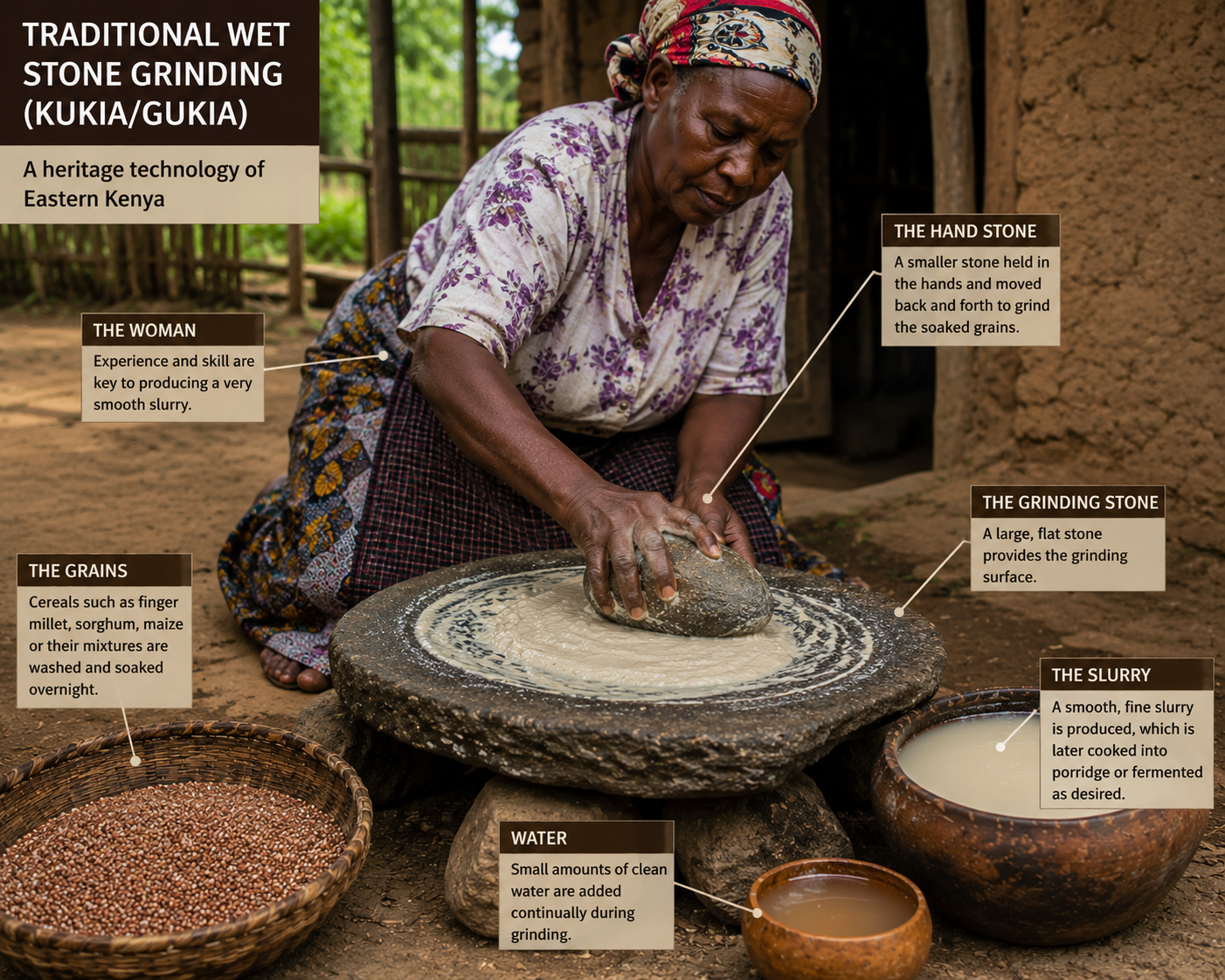
Technology Identity Card
| Attribute | Details |
|---|---|
| Technology Name | Kukia (Kamba) / Gukia (Meru) |
| Technology Type | Indigenous wet stone-grinding technology |
| Communities | Kamba, Meru, Embu, Tharaka (and likely other Eastern Bantu communities with local variations) |
| Region | Eastern and Central Highlands of Kenya |
| Primary Raw Materials | Finger millet, sorghum, maize, and other indigenous cereals |
| Equipment Required | Large grinding stone, hand grinding stone, water, clay cooking pot, wooden stirring stick |
| Primary Products | Ukii (Kamba), Ucuru bwa Gukia (Meru), related smooth cereal porridges, and Ikii (Kamba cake) |
| Current Status | Declining but still practiced in some rural households |
| Cultural Significance | Very High |
| Commercial Potential | Moderate to High |
Overview
Long before the invention of hammer mills and electric flour mills, communities in Eastern Kenya developed an ingenious method of transforming cereal grains into exceptionally smooth porridges using only stone, water, and human skill. This technology, known as Kukia among the Kamba and Gukia among the Meru, represents one of Kenya’s oldest indigenous food-processing innovations.
Unlike dry milling, Kukia/Gukia involves soaking cereal grains before grinding them on specially selected stones with the continuous addition of small amounts of water. The result is a remarkably smooth cereal slurry that produces porridges with a distinctive texture, flavour, and mouthfeel that many elders still regard as superior to those prepared using modern flour.
Although the names differ between communities, the technology is fundamentally the same and reflects a shared culinary heritage across Eastern Kenya.
Historical Background
The exact origin of Kukia/Gukia is unknown, but archaeological and ethnographic evidence from East Africa suggests that grinding stones have been used for processing cereals for thousands of years. As finger millet and sorghum became important staples among Eastern Bantu communities, these populations refined wet stone grinding into a specialized technique suited for producing smooth, nutritious porridges.
Traditionally, knowledge of Kukia/Gukia was passed from mothers and grandmothers to daughters through observation and practice. Mastering the technique was considered an important domestic skill, reflecting diligence, patience, and competence in food preparation.
Because the process required physical effort and careful control of water addition, women often developed remarkable expertise, producing uniformly smooth slurries with no visible grain particles.
Communities That Practice Kukia/Gukia
The technology is widely associated with several communities of Eastern Kenya.
| Community | Local Name |
|---|---|
| Kamba | Kukia |
| Meru | Gukia |
| Embu | Similar technology (local terminology varies and requires further documentation) |
| Tharaka | Similar technology (local terminology requires further documentation) |
While the names differ slightly due to language, the underlying technology remains essentially identical.
Traditional Equipment
Kukia/Gukia requires simple but carefully selected equipment.
1. The Grinding Stone
A large, flat stone forms the working surface. The stone is chosen for its hardness, durability, and slightly rough texture that facilitates grinding without releasing excessive grit into the food.
2. The Hand Stone
A smaller rounded stone is held with both hands and moved rhythmically across the larger stone. This action crushes and shears the softened grains into a fine paste.
3. Water Container
Small amounts of clean water are added continuously during grinding to maintain the correct consistency and prevent the paste from drying.
4. Clay Cooking Pot
Traditionally, the resulting slurry is transferred into a clay pot for cooking over a three-stone fireplace.
Raw Materials
The technology was traditionally used with:
- Finger millet
- Sorghum
- Maize
- Mixed cereal blends
The exact composition depended on seasonal availability, household preference, and intended use.
The Kukia/Gukia Process
Step 1: Grain Selection
Healthy, mature grains are selected and cleaned to remove stones, chaff, and damaged kernels.
Step 2: Washing
The grains are thoroughly washed using clean water.
Step 3: Soaking
The grains are soaked for several hours or overnight. Soaking softens the grains, making them easier to grind and may initiate mild natural fermentation depending on the duration and ambient temperature.
Step 4: Wet Stone Grinding
The soaked grains are placed onto the large grinding stone.
Using the smaller hand stone, the grinder moves rhythmically back and forth while adding small amounts of water.
This stage requires patience and experience. The goal is to produce a perfectly smooth slurry without coarse particles.
Step 5: Cooking
The slurry is transferred to a cooking pot and heated while being stirred continuously to prevent lump formation and scorching.
Depending on the desired consistency, the porridge may be prepared as a thin beverage or a thicker product. Among the Kamba, the cooked porridge may also be poured into containers and allowed to cool into a firm cake known as Ikii.
The Food Science Behind Kukia/Gukia
Although developed without modern scientific knowledge, Kukia/Gukia demonstrates remarkable engineering and food science principles.
Hydration
Soaking allows water to penetrate cereal grains, softening their structure and reducing the energy required for grinding.
Particle Size Reduction
Wet grinding produces much finer particles than many traditional dry grinding methods. Smaller particles cook more uniformly and contribute to the characteristic smooth texture.
Starch Modification
Grinding disrupts starch granules, increasing their exposure during cooking. This facilitates gelatinization, producing a cohesive and creamy porridge.
Protein and Fibre Distribution
The fine slurry creates a more homogeneous product, improving mouthfeel and reducing the perception of coarse bran particles.
Fermentation
If soaking is prolonged, naturally occurring microorganisms begin fermenting the grains. This lowers the pH, develops characteristic sour flavours, and may improve mineral bioavailability by reducing phytate content. Similar effects have been documented in other East African fermented cereal products.
Foods Produced Using Kukia/Gukia
The technology forms the basis of several traditional foods.
- Ukii (Kamba) – Smooth stone-ground cereal porridge.
- Ucuru bwa Gukia (Meru) – Traditional stone-ground porridge.
- Ikii (Kamba) – Firm cake obtained by cooling cooked Ukii.
- Other regional cereal porridges prepared using the same technology.
Although names differ, these foods share a common technological foundation.
Cultural Importance
Kukia/Gukia was much more than food preparation.
The process represented:
- Knowledge passed through generations.
- Family cooperation.
- Women’s craftsmanship.
- Care for children and nursing mothers.
- Community identity.
- Respect for traditional foods.
Freshly prepared stone-ground porridge was commonly consumed before farm work because it was regarded as nourishing and sustaining. It also featured during important life events such as childbirth, initiation, and other community gatherings.
Why Many Elders Prefer Stone-Ground Porridge
Many people who grew up consuming traditionally prepared porridge describe it as having:
- A smoother texture.
- Richer cereal flavour.
- Greater natural sweetness.
- Better aroma.
- Superior mouthfeel.
These perceptions may result from the combination of wet grinding, slow cooking, mild fermentation, and the absence of excessive heat during flour production.
Modernization and Decline
Mechanical milling has dramatically reduced the labour required to prepare porridge. While this has improved convenience, it has also contributed to the decline of Kukia/Gukia.
Many younger generations have never seen the technology practiced, and traditional grinding stones are becoming increasingly rare. Nevertheless, some households continue to prepare stone-ground porridge because of its distinctive sensory qualities and cultural significance.
Commercialization Potential
Although labour-intensive, Kukia/Gukia presents opportunities for innovation:
- Premium stone-ground porridge flours.
- Heritage food tourism.
- Culinary demonstrations.
- Cultural museums.
- Community enterprises.
- Ready-to-cook products based on traditional formulations.
Growing consumer interest in minimally processed and heritage foods could create niche markets for products inspired by this technology.
Research Gaps
Despite its importance, Kukia/Gukia remains poorly studied.
Future research should investigate:
- Historical development of the technology.
- Engineering characteristics of traditional grinding stones.
- Particle-size distribution compared with modern milling.
- Nutritional effects of wet stone grinding.
- Impact on starch digestibility and glycaemic response.
- Fermentation microbiology during soaking.
- Consumer sensory evaluation.
- Documentation of local terminology across Eastern Kenyan communities.
- Strategies for preserving indigenous food-processing knowledge.
Food Scientist’s Perspective
Kukia/Gukia demonstrates that indigenous communities developed sophisticated food-processing technologies through centuries of observation, experimentation, and adaptation. The process integrates hydration, particle-size reduction, controlled cooking, and, where desired, natural fermentation to produce foods with unique sensory and nutritional characteristics.
Rather than viewing Kukia/Gukia as an obsolete practice, it should be recognized as an important element of Kenya’s intangible food heritage. Preserving and studying this technology offers opportunities to improve our understanding of traditional cereal processing, inspire innovative heritage food products, and strengthen cultural identity.
Interesting Facts
- Kukia and Gukia describe the same traditional technology in different Eastern Kenyan languages.
- The technology relies entirely on simple tools—stone, water, and human skill—yet consistently produces remarkably smooth porridges.
- Among the Kamba, the cooked porridge can be cooled into a firm cake called Ikii, illustrating how one technology gives rise to multiple traditional foods.
- Modern milling has greatly reduced preparation time but has not fully replicated the distinctive texture and flavour of traditionally stone-ground porridge.
References
- Khayeka-Wandabwa, C., Choge, J., Linnemann, A., & Schoustra, S. (2024). Linking fermented foods to microbial composition and valorisation: Blueprint for Kenya. Food Reviews International. https://doi.org/10.1080/87559129.2024.2355992.
- Kenya News Agency. (2023). The Modern Milling Machine a Game Changer to Traditional Meru Porridge. https://www.kenyanews.go.ke/the-modern-milling-machine-a-game-changer-to-traditional-meru-porridge/
- Nout, M. J. R. (1981). Aspects of the manufacture and consumption of Kenyan traditional fermented beverages. Wageningen University. https://doi.org/10.18174/205798.
- Slow Food Foundation for Biodiversity. Ucuru wa Mukio – Ark of Taste. https://www.fondazioneslowfood.com/en/ark-of-taste-slow-food/ucuru-wa-mukio-traditional-fermented-porridge/
- Wafula, E. N., Muhonja, C. N., Kuja, J. O., & Owaga, E. E. (2022). Lactic Acid Bacteria from African Fermented Cereal-Based Products: Potential Biological Control Agents for Mycotoxins in Kenya. https://doi.org/10.1155/2022/2397767.