

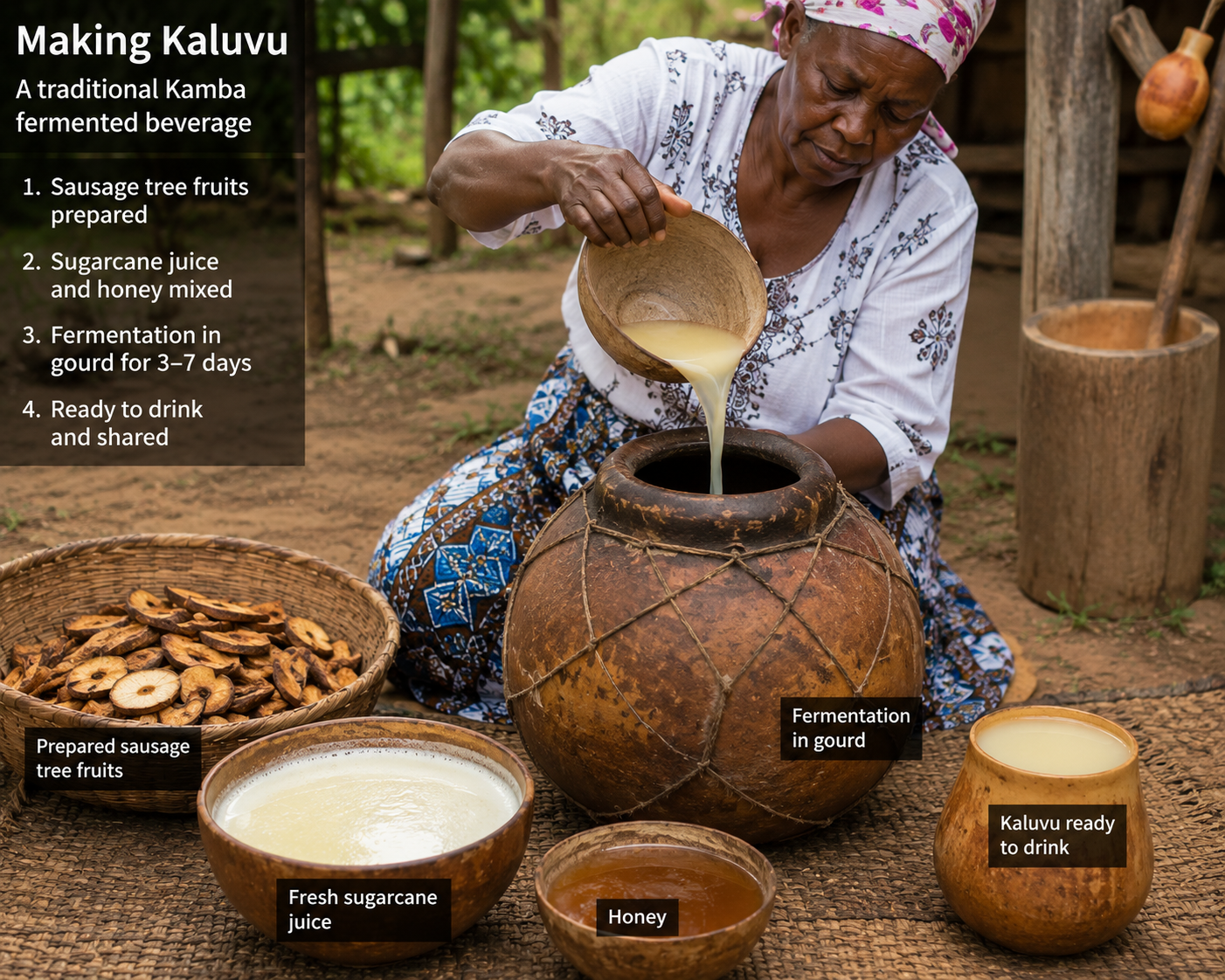
Food Identity
| Attribute | Details |
|---|---|
| Local Name | Kaluvu |
| Food Category | Traditional fermented alcoholic beverage |
| Community(ies) | Kamba |
| Region | Kitui, Machakos, Makueni and other Kamba-speaking regions of Eastern Kenya |
| Country | Kenya |
| Primary Ingredients | Sausage tree (Kigelia africana) fruit, sugarcane juice, honey, water |
| Fermentation Type | Natural spontaneous fermentation |
| Fermentation Time | Approximately 3–7 days |
| Alcohol Content | Variable depending on fermentation duration |
| Shelf Life | Short; best consumed fresh |
| Commercial Availability | Very limited |
| Commercial Potential | High |
| Scientific Evidence Level | Moderate |
Overview
Kaluvu is a traditional fermented alcoholic beverage indigenous to the Kamba community of Eastern Kenya. For generations, it has played an important role in social gatherings, cultural ceremonies, conflict resolution meetings, weddings, and communal celebrations. More than just a drink, Kaluvu represents hospitality, unity, and respect for tradition.
The beverage is produced through the natural fermentation of sugarcane juice and honey using prepared fruits of the sausage tree (Kigelia africana), locally known as Muatine in Kikamba. The sausage tree fruit contributes microorganisms and unique flavour compounds that help shape the fermentation process. Because fermentation occurs naturally without commercial starter cultures, each batch develops its own distinctive aroma and taste.
Although Kaluvu shares similarities with Muratina, the famous fermented beverage of the Kikuyu and Meru communities, each drink has its own cultural identity, preparation methods, and ceremonial significance.
History and Origin
The exact origin of Kaluvu is unknown, but oral traditions indicate that it has been brewed by the Kamba people for centuries. Historically, the beverage was prepared using ingredients readily available within the local environment, reflecting the ingenuity of communities in transforming natural resources into culturally significant foods.
Kaluvu was traditionally brewed by experienced elders or respected women who possessed specialized knowledge passed from one generation to another. Brewing techniques were rarely written down; instead, they were transmitted orally and through practical demonstration.
Traditionally, Kaluvu was never regarded merely as an alcoholic drink. It served important social functions, including welcoming honoured guests, sealing friendships, accompanying marriage negotiations, celebrating successful harvests, and honouring ancestors through libation ceremonies. During some traditional ceremonies, a small amount of Kaluvu was poured onto the ground before drinking as a symbolic offering to ancestors and as a prayer for blessings.
Despite urbanization and changing lifestyles, Kaluvu continues to be prepared during important cultural ceremonies, although its routine household production has declined over recent decades.
Communities and Geographic Distribution
Kaluvu is primarily associated with the Kamba community, particularly in the counties of:
- Kitui
- Machakos
- Makueni
Today, it is occasionally prepared by Kamba families living in Nairobi and other urban centres during weddings, family reunions, and cultural festivals. Knowledge of Kaluvu has also spread beyond the Kamba community through cultural exchange and increasing interest in indigenous Kenyan foods.
Traditional Ingredients
The principal ingredients include:
- Mature fruits of the sausage tree (Kigelia africana)
- Fresh sugarcane juice
- Honey
- Clean water
Some traditional brewers may adjust the proportions of sugarcane juice and honey according to local preferences and ingredient availability. Historically, wild honey was commonly used before the widespread availability of commercial sugar.
Traditional Preparation
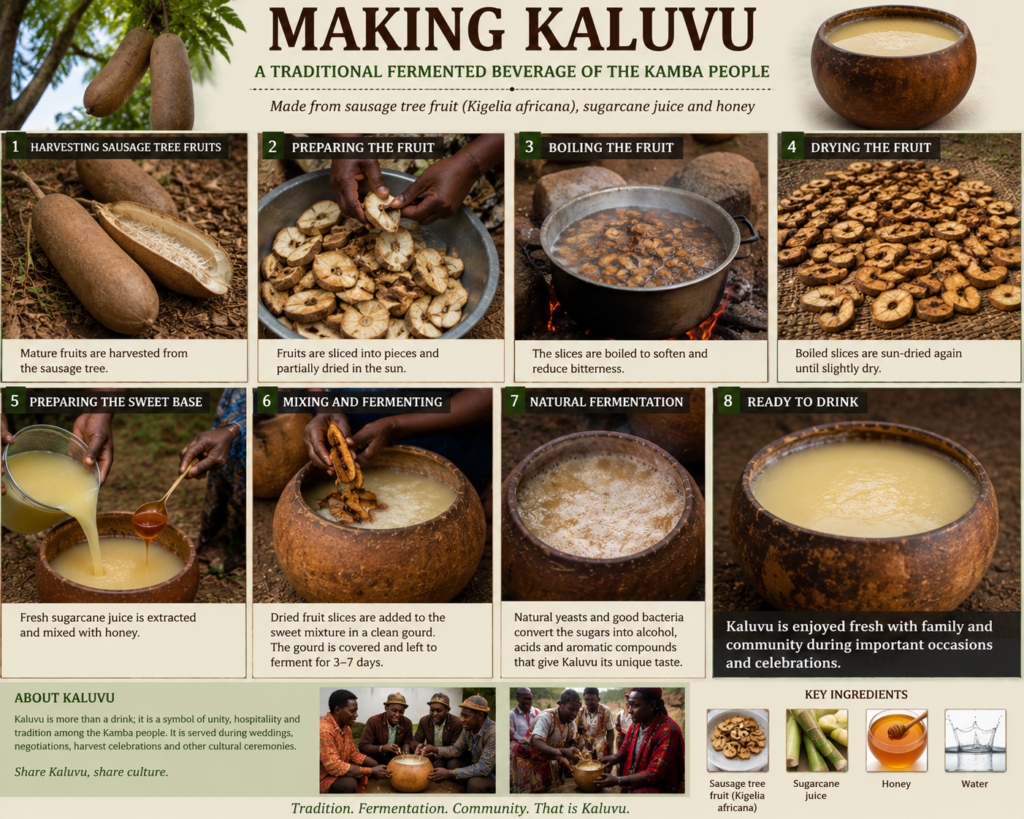
Step 1: Harvesting the Sausage Tree Fruit
Mature fruits are harvested from the sausage tree. Fresh fruits are not consumed directly because they are naturally bitter and contain compounds that can be harmful if eaten raw.
Step 2: Preparing the Fruit
The fruit is sliced into pieces and partially dried under the sun. The pieces are then boiled to soften the tissues and reduce bitterness before being dried again.
Step 3: Preparing the Fermentation Mixture
Sugarcane juice is extracted from mature canes and mixed with honey. The prepared sausage tree fruit pieces are added to this mixture.
Step 4: Fermentation
The mixture is transferred into traditional gourds, earthen pots, or modern plastic containers and allowed to ferment naturally for three to seven days at ambient temperature.
No commercial yeast is added. Instead, naturally occurring microorganisms associated with the fruit, utensils, and environment initiate fermentation.
Step 5: Consumption
Kaluvu is consumed fresh while fermentation is still active. Prolonged storage usually results in increased acidity and stronger alcoholic flavour.
The Science Behind Kaluvu
Kaluvu is produced through spontaneous fermentation. The sugars present in sugarcane juice and honey provide an excellent substrate for naturally occurring microorganisms.
Yeasts convert sugars into ethanol and carbon dioxide, while lactic acid bacteria produce organic acids that contribute to flavour development and help lower the pH. The reduction in pH limits the growth of many undesirable microorganisms, improving product stability.
Although no published study has specifically characterized the microbial community of Kaluvu, studies of similar traditional African fermented beverages indicate that species of Saccharomyces, Lactobacillus, Leuconostoc, and related microorganisms are likely to play important roles. Future microbiological studies are needed to confirm the microorganisms responsible for Kaluvu fermentation.
Cultural Importance
Among the Kamba people, Kaluvu has traditionally been much more than a beverage.
It has been served during:
- Traditional weddings
- Dowry negotiations
- Harvest celebrations
- Community meetings
- Conflict reconciliation ceremonies
- Elder councils
- Cultural festivals
Sharing Kaluvu symbolizes trust, friendship, hospitality, and unity. Elders often presided over its distribution during important gatherings, emphasizing respect and social order.
Nutritional and Health Value
Kaluvu contains carbohydrates, small quantities of minerals derived from honey and sugarcane juice, and fermentation products including ethanol and organic acids.
Like many traditional fermented beverages, it may contain beneficial microbial metabolites, although excessive alcohol consumption poses health risks. Scientific information on its vitamin composition, antioxidant capacity, and bioactive compounds remains limited and represents an important area for future research.
Food Safety Considerations
Traditional Kaluvu is generally safe when prepared hygienically using clean water, fresh ingredients, and properly sanitized containers.
Potential food safety concerns include:
- Contamination from poor hygiene during preparation.
- Excessive fermentation leading to undesirable flavour changes.
- Use of contaminated water.
- Growth of spoilage microorganisms if containers are inadequately cleaned.
Raw sausage tree fruits should never be consumed without proper processing, as they contain naturally occurring compounds that are considered toxic before drying, boiling, or fermentation.
There are currently no documented scientific reports linking properly prepared traditional Kaluvu to major foodborne disease outbreaks. However, as with other traditionally fermented beverages, hygienic production practices remain essential.
Commercialization and Future Potential
Kaluvu has considerable commercial potential within Kenya’s growing market for indigenous foods and beverages.
Potential opportunities include:
- Standardized production methods.
- Controlled fermentation using selected starter cultures.
- Bottled premium products.
- Cultural tourism.
- Export to Kenyan diaspora communities.
- Inclusion in heritage food festivals.
- Development of low-alcohol and non-alcoholic variants.
Commercialization would require standardization of recipes, quality control systems, food safety validation, and compliance with Kenyan food regulations.
Research Gaps and Future Opportunities
Despite its cultural significance, Kaluvu remains one of Kenya’s least studied traditional beverages.
Priority research areas include:
- Characterization of its fermentation microbiome.
- Identification of dominant yeast and lactic acid bacteria species.
- Nutritional composition analysis.
- Alcohol content profiling.
- Shelf-life studies.
- Consumer acceptance studies.
- Product standardization.
- Functional and probiotic potential.
- Packaging technologies.
- Commercial processing methods.
Food Scientist’s Perspective
Kaluvu demonstrates how indigenous knowledge successfully harnessed spontaneous fermentation long before modern food microbiology emerged. Its preparation reflects a sophisticated understanding of local biodiversity, particularly the utilization of the sausage tree and naturally available sugars to produce a culturally valued beverage.
With increasing global interest in traditional fermented foods, Kaluvu offers exciting opportunities for scientific research, product innovation, and cultural preservation. Modern food science can help improve its safety, consistency, and shelf life while respecting the traditional practices that have sustained it for generations.
Interesting Facts
- Kaluvu has been prepared by the Kamba community for generations using locally available ingredients.
- The sausage tree used in Kaluvu production is also used by the Kikuyu and Meru communities to prepare Muratina.
- The fruits of the sausage tree should not be eaten raw because they require processing before safe use.
- Traditionally, Kaluvu symbolized hospitality, unity, and respect during important community ceremonies.
- Interest in indigenous African fermented beverages is growing because of their cultural value and potential for commercialization.
References
- Nabatanzi, A., Nkadimeng, S. M., Lall, N., & Kabasa, J. D. (2020). Ethnobotany, phytochemistry and pharmacological activity of Kigelia africana (Lam.) Benth. (Bignoniaceae). Plants, 9(6), 753. https://doi.org/10.3390/plants9060753
- Nout, M. J. R. (1981). Aspects of the manufacture and consumption of Kenyan traditional fermented beverages. Wageningen University. https://doi.org/10.18174/205798
- Phiri, S., Schoustra, S. E., van den Heuvel, J., Smid, E. J., Shindano, J., & Linnemann, A. (2019). Fermented cereal-based Munkoyo beverage: Processing practices, microbial diversity and aroma compounds. PLOS ONE, 14(10), e0223501. https://doi.org/10.1371/journal.pone.0223501
- Wafula, E., et al. (2024). Linking fermented foods to microbial composition and valorisation: Blueprint for Kenya. Food Reviews International. https://doi.org/10.1080/87559129.2024.2355992
- The Standard. (2024). Muratina traditional brew. https://www.standardmedia.co.ke/food/article/2001494381/muratina-traditional-brew